The rules of starting a business have changed

Something is shifting. And if you’ve been feeling it, you’re not imagining it.

More people than ever are deciding to own something rather than work for someone else. Not because they’ve read a self-help book or watched one too many entrepreneur reels, but because the conditions have genuinely changed. The tools are better, the barriers are lower, and for a lot of people, the traditional path is starting to look less like a safe bet and more like a slow trade-off.

This isn’t a generational trend. It’s a human one.

Whether you’re 24 and fresh out of a degree that didn’t land you a job, 38 and tired of building someone else’s vision, or 52 and ready to finally back yourself – the pull toward ownership is the same. You want control. You want upside. You want to build something that’s yours.

The question is no longer should I start a business? For a lot of people reading this, it’s already how do I actually do it without burning through my savings and six months of my life before I even know if it works?

That’s the conversation worth having.

The old barriers are gone (mostly)

A few years ago, starting a business meant either having capital to hire people or doing everything yourself (poorly). You needed a graphic designer for a logo, a developer for a website, a copywriter for your content, an accountant for your numbers. The startup cost wasn’t just financial – it was logistical. Most ideas stalled before they even started because the execution felt impossible for a solo founder.

AI has quietly removed most of that friction.

Not in a “robots are taking over” way. In a very practical, accessible way. Today, a solo founder can draft their website copy, build a visual brand, respond to customer enquiries, create social content, and analyse their early data – all with AI tools that cost less per month than a tank of petrol.

A recent Guardian investigation into the new wave of entrepreneurs found that this is exactly how a new generation of founders is operating – using AI not as a novelty, but as their first team member. And the data backs it up: roughly 43% of Gen Z plan to start a business in 2026, the highest entrepreneurial intent of any generation, but the more telling stat is why they feel confident enough to try. AI assistants now handle copywriting, design, customer service scripts, and basic legal templates – tasks that used to require a team or a budget that most new founders simply don’t have.

The access gap has closed. What remains is the strategy gap.

The tool is not the strategy

Here’s where a lot of founders go wrong – and it doesn’t matter what age or stage they are.

They get excited about the tools. They sign up for five AI platforms, generate a logo, write a homepage, and start an Instagram account. And then they hit a wall, because none of that activity was grounded in a clear decision about what they’re actually building, who it’s for, and whether anyone will pay for it.

AI is a force multiplier. But it multiplies whatever you point it at. If you point it at a half-formed idea with no clear audience and no validated demand, you’ll just produce more half-formed content faster.

The founders who are actually building something – not just performing entrepreneurship on social media – are using AI to execute on a strategy they’ve already thought through. They know their customer. They’ve validated their idea before investing in it. They’ve made the hard decision to go, and now they’re using every available tool to move fast.

The tool saves time. The strategy saves you from wasting it.

The part nobody talks about: The decision itself

Most content about starting a business skips straight to tactics. Build a landing page. Start posting content. Launch fast and iterate.

All good advice, once you’ve made the right decision to start.

But there’s a step before all of that, and it’s the one that either sets you up or quietly dooms you from the beginning. It’s the honest assessment of your idea. The pressure test. The moment where you look at what you’re planning to build and ask: Is this actually viable? Is there a real market here? Am I solving a problem people will pay for, or a problem I’ve convinced myself exists?

Most founders skip this step – not because they’re reckless, but because there’s no clear framework for doing it. So they go straight to execution and find out six months later that the foundations were shaky.

Financial confidence remains low among aspiring founders – more than half say they lack confidence in key business decisions, from cash flow to knowing where to start – and that uncertainty is one of the biggest reasons good ideas don’t get off the ground.

The decision phase isn’t the glamorous part. But it’s the most important one.

So, where do you actually start?

If you’re at the “should I do this?” stage – which is exactly where you should be before spending a dollar or building anything – here’s the honest order of operations:

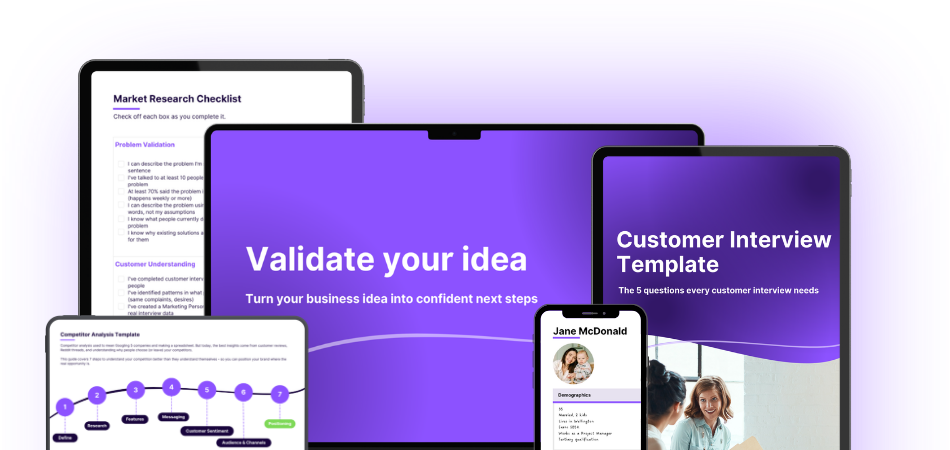
1. Validate before you build. Talk to real people who have the problem you’re solving. Not friends. Not family. Strangers who fit your target customer profile. If they wouldn’t pay for it, your idea needs more work.

2. Make the decision with your head, not just your gut. Instinct matters, but it needs to be pressure-tested. Score your idea against the things that actually predict success: market size, your ability to reach customers, your competitive edge, your financial runway.

3. Then use AI to move fast. Once you’ve made a clear, informed decision to go – that’s when the tools become powerful. Brief them well, direct them with strategy, and let them handle the execution while you stay focused on the things only you can do.

The founders who win aren’t the ones with the best AI prompts. They’re the ones who made a smart decision at the start and then used every available resource to back it up.

Not sure if your idea is ready?

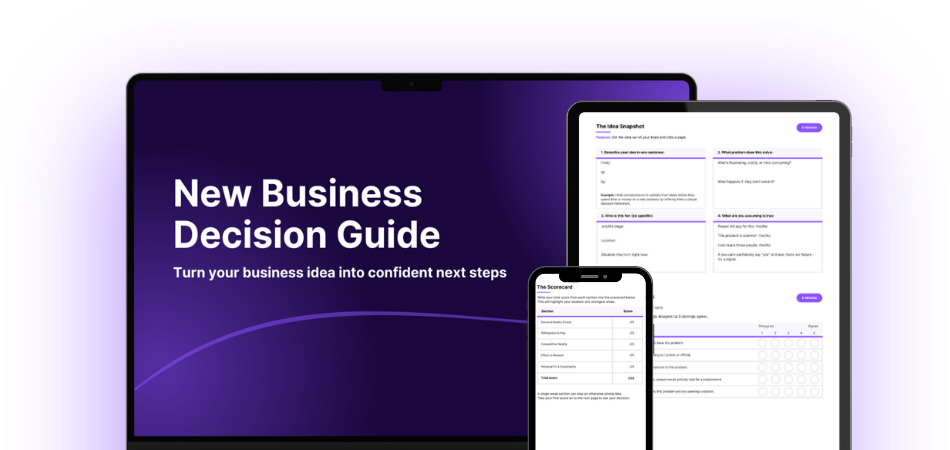
The New Business Decision Guide is for exactly this moment.

It’s a free, scored framework that walks you through the 25 questions that actually determine whether a business idea is worth pursuing – before you spend time, money, or energy building something the market doesn’t want.

No fluff. No generic advice. Just clarity on where your idea is strong, where it needs work, and what to focus on next.

Download the New Business Decision Guide – it’s free →

If you’re serious about starting something, start here.

Bold brands win: Why standing out requires being brave

In a crowded marketplace, playing it safe is the riskiest move you can make.

The brands that truly stand out aren’t the ones following the competition’s playbook. They are the ones that dare to be different – rooted in who they are, driven by their vision, and unafraid to carve their own path. And boldness isn’t just about being loud – it’s about being authentically you.

Be brave enough to be authentic

It’s easy to follow trends. But the most memorable brands are the ones that stay true to their values and identity.

Consumers today crave authenticity. They want to connect with brands that stand for something real – not those simply chasing what’s popular. Being authentic means knowing who you are as a brand and having the courage to express that consistently.

88% of consumers say authenticity is important when deciding which brands they like and support.

Whether it’s your messaging, design, or customer experience, authenticity builds trust – and trust drives loyalty.

Ask yourself: What does your brand truly stand for? And are you brave enough to let that guide everything you do?

Don’t follow the competition – Lead with your vision

Too many brands play a constant game of catch-up, copying what their competitors are doing. But imitation is not a strategy for long-term success.

Bold brands focus on their own vision. They understand their unique value and let that shape their decisions. Instead of reacting to the competition, they stay ahead by focusing on their purpose and how they can deliver real value to their audience.

When you’re clear on your vision, you create a brand that stands out – not one that blends in.

Pro Tip: Competitor analysis has it’s place for positioning your brand as unique and competitive. But try not give too much focus on what your competitors are doing and more on how you can deliver a unique experience only your brand can offer.

Embrace your own way of doing things

The brands that capture attention do things differently – their way. They break conventional molds and refuse to be boxed in by industry expectations.

Being bold means trusting your instincts and embracing your unique approach. It means speaking directly to your audience in a way only you can. This is how you create a brand that resonates deeply and builds lasting connections.

Because when you own your brands unique point of view and communicate it fearlessly, the right audience takes notice.

Why bold brands win

In a world full of noise, the brands that win are the ones brave enough to be themselves. They stand for something. They lead with vision. And they aren’t afraid to do things their way.

If you’re ready to stop blending in and start standing out, it starts with being bold.

Are you ready to be brave?

Entrepreneur’s guide to marketing: A 60-minute strategy

Building a marketing strategy sounds like something that should take weeks, a consultant, and a whiteboard the size of a wall. It doesn’t. If you’re a new business owner, what you actually need is a clear, simple framework you can work through in a single focused session and then get on with running your business.

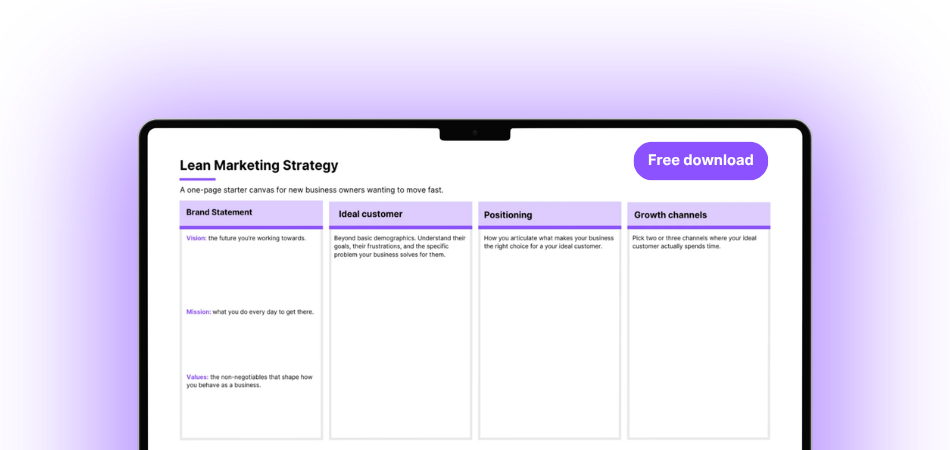
A lean marketing strategy covers six things: your brand foundation, your ideal customer, your positioning, your channels, your funnel, and your content plan. That’s it. Here’s what each one means and why it matters.

Want to skip straight to the framework?

The Lean Marketing Strategy PDF walks you through all six steps on a one-page strategy template. Free download – no catch.

1. Define your brand vision, mission, and values

Before you market anything, you need to know what you stand for. Your brand vision, mission, and values aren’t just corporate fluff – they’re the filter you run every marketing decision through. They tell you what to say, who to say it to, and how to say it.

Your vision is the future you’re working towards. Your mission is what you do every day to get there. Your values are the non-negotiables that shape how you behave as a business.

Get these three things clear and your messaging becomes a lot easier. Skip them and you’ll find yourself rewriting your website every six months wondering why nothing feels right.

2. Define your ideal customer

You can’t market to everyone – and trying to is one of the most common and costly mistakes new business owners make. The more specific you are about who your ideal customer is, the more effective every piece of marketing you create will be.

This means going beyond basic demographics. You want to understand their goals, their frustrations, and the specific problem your business solves for them. A well-defined customer profile shapes everything from your Instagram captions to your pricing page.

3. Work out your positioning – how you’re different

Your positioning statement is how you articulate what makes your business the right choice for a specific type of customer. It’s not your tagline and it’s not your elevator pitch – it’s an internal compass that keeps your marketing focused.

To find your positioning, you need to know your competitors: what they offer, where they’re strong, and where they’re leaving gaps. The business that wins isn’t always the best – it’s usually the one that’s clearest about who it’s for.

4. Choose your growth channels

Once you know who your customer is and what makes you different, you can make smart decisions about where to show up. Not every channel will be right for your business – and spreading yourself across all of them is a guaranteed way to burn out without results.

Pick two or three channels where your ideal customer actually spends time, and do those well before you add more.

5. Build your funnel

A funnel is just the path you take a potential customer on – from first hearing about you, to trusting you, to buying from you. For a new business, this doesn’t need to be complicated. You need a way to get people’s attention, a way to build trust, and a clear next step for when they’re ready to buy.

Map this out simply: how will people find out you exist? What will convince them you’re worth their money? How easy is it to actually purchase?

6. Plan your content

Content is how you show up consistently for your audience. It doesn’t have to mean a blog and a podcast and three social platforms – it means choosing the right format and channel for your audience and showing up there regularly with something useful.

The most effective content for new businesses focuses on one of three things: educating your audience on the problem you solve, building trust by showing your thinking and values, or making it easy to buy.

Put it all together in 60 minutes

The six steps above are the framework. The Lean Marketing Strategy turns them into a working document – on one-page.

It’s free. You don’t need any marketing experience to use it. And it’s designed to be done in a single sitting.

Download it here

Do I need marketing experience to use the Lean Marketing Strategy?

No. It’s written for founders who are doing this for the first time. You just need to know your business.

How is a lean marketing strategy different from a full marketing plan?

A full marketing plan covers everything in detail – campaigns, budgets, timelines. A lean strategy is the foundation that sits underneath all of that. It’s where you start, not where you end up.

What if my business is still in the idea stage?

The framework still works – in fact, doing this early helps you spot gaps in your thinking before you spend money. If you’re not sure whether your idea is ready yet, start with the free New Business Decision Guide first.

Can I really build a strategy in 60 minutes?

You can build a first version in 60 minutes. It won’t be perfect and you’ll refine it as you learn – but a clear, simple strategy you actually use will always outperform a detailed one sitting in a Google Doc somewhere.

Brand authenticity and why is matters

In a world of make-believe and AI-generated content, it’s harder than ever to truly tap into the authenticity of your brand, let alone yourself. Yes, our mums told us we were special, but if we’re all special how do we stand out from the crowd? How do we build new connections with people when we want to earn their trust, gain their preference and keep them coming back? There’s only one way you should be doing this – and that’s with authenticity. 

Brand authenticity has become more than just a buzzword, it’s a defining factor for success. Whether you’re a small business owner, an aspiring entrepreneur, or a recent marketing graduate, understanding the importance of authenticity in your brand is crucial. 

In this article, we’ll explore what authenticity truly means, why it’s vital for your business, and how to build an authentic brand that resonates with your audience.

What is authenticity?

Authenticity, in the context of your brand, means staying true to your core values, beliefs, and promises. It’s about being genuine, transparent, and consistent in your business practices. When your brand is authentic, it reflects the essence of who you are and what you stand for. 

It’s the difference between doing something for the sake of earning money versus doing something that truly aligns with your brand vision. Which is easier said than done.

Why is brand authenticity important?

1. People should know who they are doing business with:

Customers want to connect with the face behind the brand. When your business exudes authenticity, it’s easier for people to understand and relate to your mission and vision. This humanizes your brand and fosters trust. 

2. Build trust with people: 

Trust is the foundation of long-lasting customer relationships. Authenticity is the key to building and maintaining trust. People are more likely to engage with and remain loyal to a brand they trust.

3. People will tell others about you:

Satisfied customers become brand advocates. When they experience an authentic connection with your business, they’re more likely to share their positive experiences with friends, family, and online communities. Word-of-mouth marketing is invaluable.

4. It helps you grow organically for a long time: 

In an era of ever-changing trends, chasing quick profits can lead to short-lived success. On the other hand, authentic businesses focus on their unique purpose, addressing real problems and providing value. This long-term perspective allows you to grow steadily, rather than seeking fleeting gains.

How to build an authentic brand?

1. Define who your brand is and what it stands for:

Start by identifying your brand’s core values and mission. What do you want to achieve, and what principles guide your decisions? This foundational Brand Marketing Strategy will be your North Star.

2. Align your business activity with this purpose: 

Every business decision should be measured against your brand’s purpose (vision). Create a culture within your organisation that encourages questioning if a decision aligns with your values and mission.

3. Put yourself in your customers’ shoes:

Empathy is a powerful tool. Continuously consider how your customers perceive your brand. Be honest, and transparent, and ensure your actions match your words. Remember, customers are excellent lie detectors, if they sense you are not telling the truth they are more likely to tell people about it. 

People are more likely to tell their friends about a bad experience than about a good one.

For every bad review or customer you lose, make sure you understand their experience and put in place better systems or processes to make sure it doesn’t happen again. 

4. Learn from your mistakes: 

It’s impossible to please everyone all the time. When you encounter negative feedback or lose a customer, take it as an opportunity to improve. Listen, learn, and adapt. By doing so, you demonstrate your commitment to growth and authenticity.

5. Don’t be afraid to be yourself:

Authenticity should start with you. Share your story, your passions, your vulnerabilities, and your strengths. When people can connect with the human side of your brand, trust is nurtured. Be approachable and relatable.

How to find your brand authenticity

1. Soul-searching:

Begin by asking yourself what inspired you to start your business. What values and principles guide your decisions? Your brand’s authenticity often mirrors your personal values. For example, brands like Ecostore are driven by values of sustainability and eco-friendliness. By emphasising natural ingredients, responsible packaging, and a commitment to reducing their environmental footprint, these brands appeal to consumers who also value sustainability and ethical practices.

2. Customer feedback: 

Pay close attention to what your customers are saying. Their comments and suggestions can help you refine your brand’s identity and offerings to align with their needs better. Build a system for capturing customer feedback, you can do this through surveys, interviews or automated NPS software. Put time aside each month to review the feedback and implement improvements to your offering. Don’t forget to thank your customers for their feedback, they are doing you a favour by sharing their opinion. 

3. Competitor analysis:

Study your competitors to identify gaps in the market and areas where you can stand out authentically. This market research will help you position your brand uniquely. If 12 brands are offering the same product or service, what makes yours special and unique? Yes, all software has the benefit of ‘saving you time’ but what is it about you that makes your software unique? Lean on your authenticity and brand purpose, and give your customers a reason to choose you over the competition. 

Brand authenticity isn’t just a trendy concept – it’s a business imperative. By staying true to your values, consistently delivering on your promises, and engaging with your audience authentically, you can build a brand that people not only trust but also passionately advocate for. In the long run, authenticity will be your greatest asset on your journey to business success.

How to create marketing personas that actually work

Personas are one of the most important tools in your business’s tool kit. They outline who your customers are, their challenges, desires and goals, this is incredibly important because after all, without your customers, you wouldn’t have a business. Yet even as a crucial business instrument, it’s common for small businesses to have only created them during their draft business planning stage but haven’t looked at them since.

A survey conducted by Keap found that only 29% of small businesses use buyer personas to guide their marketing efforts. The survey also found that the majority of small business owners struggle to identify their target audience and understand their needs and preferences.

My marketing ears bleed when I hear this! Let’s work through this together.

What is a marketing persona? 

Marketing personas, also known as buyer personas or customer avatars, are fictional representations of your ideal customers. They help give you a deeper understanding of your target audience by identifying their needs, interests, preferences, and behaviours. 

There are many different formulas to create personas, however they all follow a fairly similar structure. Creating a persona and locking it in a drawer will not help your business, you’ll need to actually use the information within it to help guide your business. 

A good persona can outline a positioning strategy for how your business can solve more of your target market’s problems. You can do this through testing and improving your marketing messaging, by developing better solutions or by building different product offerings that can better serve your customers and offer new revenue streams for your business.

Here’s a guide for creating effective marketing personas

Define your target audience: 

Start by defining the demographics of your target audience, such as age, gender, location, education level, income, etc. You can use customer data, market research, or social media analytics to gather this information.

Conduct research:

Conduct qualitative and quantitative research to gather more information about your target audience. This can include surveys, focus groups, interviews, social media listening, and website analytics. Use this data to identify patterns and trends that can help you create more accurate personas.

Identify pain points and goals: 

Identify the pain points, challenges, and goals of your target audience. This will help you understand their motivations and what drives them to make a purchase. You can gather this information through surveys or interviews.

Create personas: 

Based on the data you’ve collected, create a list of fictional personas that represent your target audience. Each persona should have a name, age, job title, and a brief summary of their background, goals, challenges, and interests. Use visuals, such as photographs or illustrations, to bring your personas to life. 

Create at least three personas who are most important to your business, these can be the purchase decision makers or the influencers of those decisions. Pick your top three and explore their challenges, desires and goals.

Note in each one what they are influenced by, are they likely to be convinced by their friends or children to make a purchase, or are they making the purchase on behalf of their business?

Download this free marketing persona template.

Marketing persona template

Download this free template and start defining your target audience today. Includes instructions and an example persona.

Use personas for marketing: 

Once you have created your personas, use them to inform your marketing strategy. Create content, ads, and messaging that speak directly to the needs and interests of each persona. Use their pain points and goals to create targeted campaigns that resonate with them. 

Draw on the language and words they use to describe their challenges, speaking in a language they understand. They will recognise that you understand their challenges and therefore likely have a good solution for them. 

Note where they ‘hang out’ and where they learn new information. Are there certain websites or social media platforms where they spend a large portion of their time? This could be news sites, Tiktok, Medium or LinkedIn. They could also be part of Facebook groups or community groups where you can target your advertising strategy to these audiences. 

Update personas regularly: 

Your target audience will likely change over time, so it’s important to update your personas regularly. Keep an eye on market trends and customer feedback to ensure your personas remain accurate and relevant. It is recommended you update your personas at least once a year, or more often if there are significant shifts in your industry. Keeping your personas up to date will help you keep a competitive advantage in your market.

In conclusion, marketing personas can help you create more effective marketing campaigns by identifying the needs and interests of your target audience. By following these steps, you can create personas that accurately represent your target audience and help you achieve your business growth goals.

More marketing tools to grow your business

What is brand positioning

Brand positioning is the strategic steps you take to create a positive perception of your business in the minds of your customers. 

How to conduct a competitor analysis

A simple 6-step guide for small business owners to conduct a competitor analysis to inform a positioning strategy.

The ultimate guide to building trust with customers through consistent branding

Building trust with customers is essential to the success of any business, and consistent branding is one of the most effective ways to establish that trust. When customers see a consistent and cohesive brand identity across all touchpoints, they feel confident in their decision to do business with that company. 

In this guide, we’ll explore the various ways you can use consistent branding to build trust with your customers.

Develop a clear brand voice and message

The first step to building trust with customers through branding is to develop a clear and consistent brand voice and message. Your brand voice is the tone and personality you use when communicating with your audience, and your brand message is the core idea or value that your brand represents.

When you have a clear brand voice and message, it helps customers understand what your brand stands for and what they can expect when doing business with you. This consistency helps build trust over time and establishes a strong foundation for your brand.

Use consistent visual elements

Visual consistency is another crucial aspect of building trust with customers. Your brand’s visual elements, such as your logo, colour scheme, typography, and imagery, should be consistent across all touchpoints, from your website to your social media channels to your packaging.

When customers see the same visual elements repeatedly, it reinforces your brand identity and makes your business more memorable. It also conveys a sense of professionalism and attention to detail, which can further establish trust with your audience.

Provide a consistent customer experience

Consistent branding doesn’t just apply to your visual identity; it also applies to the overall customer experience you provide. Your customers should have a consistent experience when interacting with your business, whether they’re visiting your physical store or browsing your website.

This means ensuring that your customer service is consistently excellent, your products or services are consistently high quality, and your brand values are consistently reflected in all aspects of the customer experience.

Be authentic and transparent

Authenticity and transparency are critical to building trust with customers. Your brand should be authentic in its messaging, values, and voice, and you should be transparent about your business practices and processes.

When customers feel that your brand is authentic and transparent, it creates a sense of honesty and openness that can help build trust and loyalty over time.

Maintain consistency over time

Finally, it’s essential to maintain consistency over time. Consistent branding is not a one-time effort but a long-term commitment to building a strong and recognizable brand identity.

This means regularly assessing your branding efforts and making adjustments as necessary to ensure consistency across all touchpoints. It also means investing in ongoing efforts to reinforce your brand identity, such as creating consistent content, updating your visual identity as needed, and staying up-to-date with industry trends and best practices.

In conclusion, consistent branding is a powerful tool for building trust with customers. By developing a clear brand voice and message, using consistent visual elements, providing a consistent customer experience, being authentic and transparent, and maintaining consistency over time, you can establish a strong and recognizable brand identity that inspires trust and loyalty among your audience. 

Don’t just take my word for it though, look at your favourite trusted brands and see if they tick all of these boxes. 

More resources to help you build trust in your brand

Brand consistency and why it matters

Consistency is key when it comes to building a brand that lasts. Learn more about brand consistency and why it matters.

Brand marketing strategy

Build business growth by developing a brand marketing strategy. Gain consistency, clarity and collaboration across your business.

Brand consistency and why it matters

Consistency is key when it comes to building a brand that lasts. And I’m not just talking about posting the occasional cute Instagram pic or updating your website once in a blue moon. No, no, no. I mean staying true to your brand values, messaging, and visual identity across all your touchpoints – from your business cards to your social media channels to your email signatures.

Now, I get it. You’re a small business owner. You have a million things to juggle, and branding might not be at the top of your to-do list. But here’s the tea: a strong and consistent brand can be a game-changer for your business. Don’t believe me? Let me give you some examples.

Consistency breeds familiarity

You want your customers to recognize your brand no matter where they see it. Think about some of the most successful brands out there – Coca-Cola, McDonald’s, Nike. Their logos and slogans are so iconic and recognizable that you can spot them from a mile away. And that’s not by accident. It’s because they’ve consistently used the same branding elements across all their channels for decades.

But what about small businesses? Let’s say you’re a local bakery. You want your regulars to be able to spot your storefront from down the block. You want them to recognize your branding on your packaging, your website, and your social media. Consistency across all those touchpoints builds trust with your customers and keeps your brand top of mind.

Consistency makes your brand look more professional

If your branding is all over the place, with different fonts, colors, and messaging on every platform, it’s going to look amateurish. And let’s be real – customers aren’t going to take you seriously if your brand looks like it was thrown together in five minutes. 

On the other hand, if you have a consistent brand identity that looks polished and professional, customers will perceive your business as more trustworthy and reliable. Plus, it shows that you’re putting in the effort to make your business look its best.

Another consideration is keeping your brand up to date and relevant with your target audience, customers might not be so responsive to a brand that is so old that it’s now come back into fashion as ‘retro’. However, it is important to remain consistent with your roots and the soul of your brand. Rebranding can breathe new life into your image while holding true to your origins and brand equity you may have gained.

Consistency helps you stand out in a crowded market

Let’s say you’re a small online boutique selling handmade jewelry. There are hundreds – if not thousands – of other businesses doing the exact same thing. So how do you differentiate yourself? By having a unique and consistent brand identity that sets you apart from the competition.

Maybe you have a signature colour scheme that you use across all your branding. Maybe you have a quirky tagline that shows off your brand’s personality. Whatever it is, having a consistent and memorable brand identity helps you stand out in a sea of similar businesses.

So, what’s the bottom line here? Consistency matters

It’s not enough to have a cool logo or a catchy slogan. Your brand needs to be consistent across all your channels if you want to build trust with your customers, look professional, and stand out in a crowded market.

And here’s the thing – it doesn’t have to be overwhelming. Start by defining your brand values and messaging. Then, choose a visual identity that reflects those values and stick with it across all your touchpoints. Use the same fonts, colours, and imagery on your website, social media, packaging, and any other branding materials you use.

It might take some effort and planning upfront, but trust me – it’ll be worth it in the long run. Your brand will be stronger, more memorable, and more recognisable. And that, my friend, is a recipe for success.

More resources to help you build and grow a consistent brand

How to conduct a competitor analysis

A simple 6-step guide for small business owners to conduct a competitor analysis to inform a positioning strategy.

Brand marketing strategy

Build business growth by developing a brand marketing strategy. Gain consistency, clarity and collaboration across your business.

Why is competitor analysis important

When was the last time you did a competitor analysis?

Scratch that… have you ever done a competitor analysis? 

It’s very common for small businesses to not know who they are competing with. However, if you are serious about scaling your business and want to win more sales in your target market – you need a game plan of how to position your brand as the preferred option among competitors.

85 percent of consumers conduct online research before making a purchase online

When your customers go searching for a solution, don’t you want to stand out from the crowd?

That’s where positioning comes in, and competitor analysis will help you create a strategy that’s sure to turn a few heads.

What is competitor analysis?

Competitor analysis is the investigation of other businesses that offer the same or similar solution for your target market. It’s the process of analysing the strengths and weaknesses of these businesses and comparing them to your own. Competitor analysis allows you to gain important insight to help you position and grow your brand.

Why is competitor landscape analysis important?

Competitor analysis or competitor landscape analysis is important to inform your strategies on how to:

  • grow your business
  • make better products and design better services
  • communicate clearly with your customers
  • remain the top choice for your customers
  • build your brand equity
  • differentiate your brand as unique
  • stay on top of market shifts
  • pivot faster when the market and customer needs change

Competitor analysis not only informs you of who else might be serving your customers, it also allows you to understand how your customers search for solutions and make comparable decisions between choosing your product or someone else’s. 

By understanding the competitive landscape you’ll identify whether you are dealing with selective or primary demand, which can greatly impact your marketing and brand positioning strategy. 

Difference between selective and primary demand

The difference between selective and primary demand can help determine the type of marketing decisions and messaging you place in front of your target market. 

Selective demand 

Selective demand is where the customer understands they have a problem and they decide to select a product or service to solve their problem. This is the case with highly competitive markets where there are many options for one type of solution. If your solution sits within a selective demand market, you might want to look closely at your competitors to make sure you are differentiating and offering more value to the customers making their selection.

Primary demand

Primary demand is where customers do not recognise they have a problem that can be solved for them. This is often the case with new products or services that do not already exist in the market. Messaging can be focused around educating the market about your new solution. Highlighting the problem they might not know can be solved with your one-of-a-kind solutions on the market.

How to differentiate your brand

Once you have a solid understanding of your competitive landscape and their strengths and weaknesses in comparison to yours. You can begin to start building your differentiation strategy or brand positioning strategy.

Conduct a competitor analysis

Researching your competitors will help you understand where you sit in the minds of your customers. You wil gain an understanding of what you offer your customers that no one else in the market can. Then using this as your unique selling proposition, you can differentiate your solution as bringing more value to your target market. Read more about how to conduct a competitor analysis.

Leverage your unique selling proposition

No one can build the brand you have set out to create, just like people, we are all unique and there are no two alike. If you have a thorough understanding of your customers needs and wants, use your unique-ness to offer them more value. While there may be similarities in your branding, language and pricing, the key here is to position your brand as different and offer something that your competitors simply cannot.

Highlight your competitive advantage

Don’t be shy to shout about your advantages over your competitors, chances are your customers have done their research online and will be comparing your solution against theirs. Make your advantage known, talk about it on your homepage, on your landing pages, on your social media and in your emails. And, like anything – test, measure, and try again.

Remain the top choice for your customers

Competitor analysis can be a daunting task if you’re a small business owner, entrepreneuer or an marketing team of one. However, it’s a key part of your growth strategy and something you need to stay on top of if you want to remain the best choice for your customers. You will need to constantly position your solution as the better choice in the eyes of your customer. Now how can you do that without monitoring what they are finding online so you can position your brand as more desirable? 
When asking yourself how often you should review your competitors, best practice says quarterly, if not monthly if you have the time. However, it’s wise to not dwell on the competition too much. Focus on what you can control, your brand and meeting your customers needs.

Don’t know where to begin?

This simple 6-step guide to competitor analysis will get you started!

Jillian Whitmore
Jillian Whitmore, Author

I’ve worked with companies in both start-up and scale-up phases. I love helping new small businesses make sense of marketing fundamentals and empowering them to take their business growth into their own hands. Confidently scaling their businesses. Read more insights here. Subscribe to the Mood Marketing newsletter to receive insights direct to your inbox.

How to conduct a competitor analysis

A competitor analysis is not as technical as it sounds, you just have to be brave enough to start looking.

As a small business owner, this can sometimes be daunting if you have never seen who you are competing with to win your customer’s attention and business. Conducting competitor analysis has three main components. Understanding who your competitors are and the difference between direct and indirect competitors, doing the competitor research. Finally creating perceptual maps to visualise your findings and identify gaps in the market to inform your positioning strategy

Difference between direct and indirect competitors

A key step in analysing your competitors is understanding the difference between direct and indirect competitors.

A direct competitor is someone who offers the same solution to your customers, to solve the same need. Comparing apples with apples.

An indirect competitor is someone who solves the same problem for your customers but whose offering is different. Comparing apples with oranges.

For example, restaurants that sell cheeseburgers are all direct competitors for each other. Whereas, Subway is an indirect competitor for these restaurants because while they may offer a product that can solve the same problem (hunger) the products themselves are quite different.
Understanding your competitors will help you determine your market share and think deeply about the way you position your brand. You’ll learn what your customers see by researching products similar to yours or typing a question into Google to find out who is serving a solution to a problem.

Competitor analysis research

For small businesses with small budgets, simple competitor research can be done easily through Google. There are expensive agencies that can provide research for you, but with a bit of spare time it’s easy to gain enough understanding of your competitors to start building a positioning strategy yourself. There are 6 main steps for how to do competitor research and they can all be done with a laptop and a bit of snooping.

1. Define your offering and who you serve

First and foremost, you will need to define your market, your products/services and the benefits you offer your customers. This way, when researching for other competitors, you know what to look for. Many new businesses have a hard time defining what it is that they do, this is especially common for newer products and services that have yet to be tested in the market. Make sure you know what it is you offer, who it’s for, the benefit and the problem you are solving.

2. Research competitors who offer a similar service (direct competitors)

Start to look at competitors who offer the same services/products, solve the same problems and serve the same people. Narrow down your search to be relevant to the market you serve, for example; in a geographic region (people who live in Wellington, New Zealand). Search for the problems you solve by thinking about what your customers will be asking Google. Take note of how your competitors are offering and positioning their solutions in comparison to yours.

3. Compare their features and benefits to yours

Feature comparison is a key decision-making factor when your customers are choosing a product or service. Look at your competition’s product or service and take note of the features and value they describe. Read their websites while putting yourself in your customers’ shoes. 

Ask yourself: 

  • How does the customer journey feel? 
  • Do they have useful information?  
  • Are they making it easy for a customer to purchase a product or book a service?
  • What value do they offer that might be different to yours? 
  • Do you have more or better features than they do? 
  • Do you offer something that they don’t, or vice-versa? 

An easy way to make this comparison is to create a simple list of features and benefits that you offer and then plot where each of your competitors sit in comparison.

You may find that you are the only business offering a certain feature and you know it solves a massive problem for your customers. You can then make strategic decisions to highlight this feature in your marketing and offer it from a place of confidence. Using your key feature differentiator to position your product as more desirable because of its lucrative feature.

4. Discover what language they use to describe their value

Look at how your competitors position their solutions. You can do this by reading the language they use to describe their solution and the problem they solve. 

Ask yourself: 

  • What language do they use? Is it highly emotional, passive or direct? 
  • What benefits do they highlight? 
  • Do they have social proof from their customers? 
  • Do they have testimonials on their website? 
  • Do they have online reviews that validate their website messaging?
  • How would your customer feel reading their website?

A lot of businesses have a core brand language that they use to consistently communicate with their customers. Think about the language they are using and how it compares to yours all while putting yourself in your customer’s shoes. Take note of how they describe their solution, if you realise you are using the same adjectives, it might be worth thinking about changing yours up to grab more attention.

5. Understand their audience size and engagement level

Look at their social media followers and online presence, are they featured in the news regularly, do other publications and news sites talk about them? From this, you can gauge how big their reach might be in comparison to yours. This might also give you some ideas about how your business shows up online, and how you engage with your target audience.

6. Compare their pricing and packaging

Look at their pricing, do they offer a cheaper solution than yours? Is their pricing higher than yours? Does their pricing reflect the benefits they discuss on their website?

Pricing and packaging can be a difficult thing to compare. It comes down to how your customers value what you offer. Is there an additional feature or service you could offer to your package to make it stand out to your competitors? Can you group your products or services together that offers more value to your customer? 

Perceptual mapping

A perceptual map (or positioning matrix) is a visual graph that highlights where your brand sits in the minds of your customers in comparison to your competitors. This is a great tool to identify gaps in the market where no one is currently serving your customers, and it can also aid in positioning strategies to differentiate your brand and compete more fiercely with others in the market. 

Start by selecting the points of differentiation that are important to your customer when they are comparing solutions and place them on the axes. Plot yourself and your competitors on the matrix like the example shown. From this, you should be able to recognise who your biggest competition is and strategize to position your brand as the preferable option. Doing this exercise may also present opportunities in the market that you could look to fill. Don’t just do one matrix, think about other points of importance for your customer’s decision-making and develop a range of positioning graphs.

A key thing to keep in mind is that a traditional perceptual map needs to reflect the actual perception of your customers and not your biased opinion of where you think your brand sits among others in the market.

However, you can also use it to map your competitors against your own without having to rely on customer research and expensive data sources. Using this matrix as a positioning tool can help you define your positioning strategy and stand out from the competition. 

Next Steps

If you are a small business owner, revisit your competitor analysis at least twice a year to stay ahead of your competitors. If you are a larger business with larger growth goals and in a highly competitive industry, think about dedicating time at least every quarter to reassess the competition and re-evaluate your positioning strategy. 

After all your competitors may very well be analysing your positioning and trying to win top choice in your customer’s minds too. Staying on top of the changes in positioning will mean your business is more agile and can pivot appropriately to maintain the top spot. Read more about why competitor analysis is important.

Download the free competitor analysis template to get started!

Jillian Whitmore
Jillian Whitmore, Author

I’ve worked with companies in both start-up and scale-up phases. I love helping new small businesses make sense of marketing fundamentals and empowering them to take their business growth into their own hands. Ready to scale up their businesses. Read more insights here.

What is brand positioning

What is brand positioning?

Brand positioning is the strategic steps you take to create a positive perception of your business in the minds of your customers. It’s how you position your solution against competitors in the market and endeavour to make yours more favourable. 

Brand positioning is what you want your brand to be known for. It’s the way you connect and communicate your products and services to your customers. With a goal of creating a desire to purchase that leads to advocacy. Successful brand positioning is meeting the needs of your customer better than any other competitor in the market.

In their book, Positioning: The Battle for Your Mind, Al Ries and Jack Trout talk about, “How to make and position an industry leader so that its name and message wheedles its way into the collective subconscious of your market and stays there.”

Sounds easy right? Brand positioning is basically mind control.

Why is brand positioning important?

A brand positioning strategy is a well researched plan to scale your business and achieve your desired market share. The more minds your brand can influence, the more referrals, word of mouth, and brand awareness your business will have. How you position your brand and how you wheedle your way into your customers minds is key to your brand growth strategy.

Brand Management Mood Marketing

What is an example of brand positioning?

In New Zealand, this could be as simple as, “where everyone gets a bargain.” We all know that’s The Warehouse, not just because of the catchy jingle, but we honestly feel like we can go to The Warehouse to get a bargain. They know their customers want a bargain, so that’s what they deliver to the market and position their brand accordingly. 

Brand positioning is the proof of a company living their values and delivering on their promises. As The Warehouse says on their website page, Here for Good, “…we are committed to making sustainable living easy and affordable for everyone.” Although, it’s not just what they publish on their website, it’s how their brand has been positioned in our minds. Next time you’re in need of an affordable piece of homeware, clothing or halloween costume – where do you instantly think of? The Warehouse!

What is a brand positioning strategy?

A brand positioning strategy aims to increase customer loyalty, brand equity, and the willingness of customers to purchase from your business. The Branding Journal defines a brand positioning strategy as a combination of customer wants, business capabilities, and competitors in the market. These three components of your brand positioning strategy involve quite a bit of thought and require ongoing consideration as the market changes. 

Let’s break each of these down further.

Brand positioning strategy mood marketing

Customers

Your brand is what your customers think, not what you say.

If you’re wanting to wheedle your brand into the minds of your customers, you better have a good understanding of what they want. Knowing the needs and desires of your customers is how you develop better solutions to their problems and create messaging that resonates with them. Your first step to building a brand positioning strategy is to gather insights

Customers won’t pay attention to things that don’t offer them something they need. You want your messaging to be thumb-stopping and not to ‘feel like marketing’ but be something that is useful and of value to your customers. Be the solution they would love to tell all their friends about.

Market research and digital surveys are a great way to understand your customers and build your personas. However, the best form of customer research is to go out and actually speak to them, face-to-face. Hear straight from the horse’s mouth! Take this opportunity to ask questions about their problems. Don’t talk about your solution, you aren’t there to sell them anything, you’re there to listen to them.

Capture the words they use to describe their frustrations and use them in your marketing. Ask them what they know and think of your brand, what they like or dislike about your brand, and how they feel about competitor brands in the market.

This is valuable research and a crucial component of your brand positioning strategy. Don’t just talk about your promises to solve their problems. Prove to them in all your brand behaviour that you are true to your messaging and make sure you can deliver the solution.

Capabilities

Make sure your business has the capability to deliver on your strategy. 

It’s one thing to define a brand positioning strategy but if you cannot commit the necessary resources and time to delivering it, you will never reach the position you are aiming for. For example, say you want your brand to be in the top five choices in your product category. You learn how your customers think, you find out what their problems are and you come up with a new product and a marketing plan to go to market. But, then you get swamped by running your business and serving your existing customers. What about those positioning goals? What about the growth forecast you’ve sold to your investors?  

With any strategy, it’s not just about the actions of how you are going to achieve your goal, more importantly it’s how you are going to find the resources and funds to deliver the strategy. 

Don’t let your hard earned research and strategic ideas go to waste, build a plan and resource it appropriately. This may involve out-sourcing some of the deliverables, which can be a great way to access talent you might not have in-house. Grow your brand equity by ensuring your strategy is resourced appropriately.

Competitors

Differentiate your solution against competitors in the market. 

Think about your customers and their decision making journey, how do they research problems and find information? By following their journey you can easily see who else is in the market offering a similar solution to you.

Desktop research is a simple place to begin and can give you an idea of what your customers might see during their research. This involves a little bit of snooping, it’s not cheating to look over your shoulder to see what the other guy wrote for question 3. It’s a necessary part of competitor research and developing your brand positioning strategy. 

Compare your offerings, features, and how they describe their solution. What language do they use and what promises do they make? You can learn a lot from a humble laptop and a few hours of googling. Don’t feel disheartened if you find out your competitors are doing the same thing as you. Use this information to fuel your positioning and differentiate your brand from the competition. 

Strategically position your brand for the customer, become the preferred option and meet their needs better than any competitor in the market.