Something is shifting. And if you’ve been feeling it, you’re not imagining it.
More people than ever are deciding to own something rather than work for someone else. Not because they’ve read a self-help book or watched one too many entrepreneur reels, but because the conditions have genuinely changed. The tools are better, the barriers are lower, and for a lot of people, the traditional path is starting to look less like a safe bet and more like a slow trade-off.
This isn’t a generational trend. It’s a human one.
Whether you’re 24 and fresh out of a degree that didn’t land you a job, 38 and tired of building someone else’s vision, or 52 and ready to finally back yourself – the pull toward ownership is the same. You want control. You want upside. You want to build something that’s yours.
The question is no longer should I start a business? For a lot of people reading this, it’s already how do I actually do it without burning through my savings and six months of my life before I even know if it works?
That’s the conversation worth having.
The old barriers are gone (mostly)
A few years ago, starting a business meant either having capital to hire people or doing everything yourself (poorly). You needed a graphic designer for a logo, a developer for a website, a copywriter for your content, an accountant for your numbers. The startup cost wasn’t just financial – it was logistical. Most ideas stalled before they even started because the execution felt impossible for a solo founder.
AI has quietly removed most of that friction.
Not in a “robots are taking over” way. In a very practical, accessible way. Today, a solo founder can draft their website copy, build a visual brand, respond to customer enquiries, create social content, and analyse their early data – all with AI tools that cost less per month than a tank of petrol.
A recent Guardian investigation into the new wave of entrepreneurs found that this is exactly how a new generation of founders is operating – using AI not as a novelty, but as their first team member. And the data backs it up: roughly 43% of Gen Z plan to start a business in 2026, the highest entrepreneurial intent of any generation, but the more telling stat is why they feel confident enough to try. AI assistants now handle copywriting, design, customer service scripts, and basic legal templates – tasks that used to require a team or a budget that most new founders simply don’t have.
The access gap has closed. What remains is the strategy gap.
The tool is not the strategy
Here’s where a lot of founders go wrong – and it doesn’t matter what age or stage they are.
They get excited about the tools. They sign up for five AI platforms, generate a logo, write a homepage, and start an Instagram account. And then they hit a wall, because none of that activity was grounded in a clear decision about what they’re actually building, who it’s for, and whether anyone will pay for it.
AI is a force multiplier. But it multiplies whatever you point it at. If you point it at a half-formed idea with no clear audience and no validated demand, you’ll just produce more half-formed content faster.
The founders who are actually building something – not just performing entrepreneurship on social media – are using AI to execute on a strategy they’ve already thought through. They know their customer. They’ve validated their idea before investing in it. They’ve made the hard decision to go, and now they’re using every available tool to move fast.
The tool saves time. The strategy saves you from wasting it.
The part nobody talks about: The decision itself
Most content about starting a business skips straight to tactics. Build a landing page. Start posting content. Launch fast and iterate.
All good advice, once you’ve made the right decision to start.
But there’s a step before all of that, and it’s the one that either sets you up or quietly dooms you from the beginning. It’s the honest assessment of your idea. The pressure test. The moment where you look at what you’re planning to build and ask: Is this actually viable? Is there a real market here? Am I solving a problem people will pay for, or a problem I’ve convinced myself exists?
Most founders skip this step – not because they’re reckless, but because there’s no clear framework for doing it. So they go straight to execution and find out six months later that the foundations were shaky.
Financial confidence remains low among aspiring founders – more than half say they lack confidence in key business decisions, from cash flow to knowing where to start – and that uncertainty is one of the biggest reasons good ideas don’t get off the ground.
The decision phase isn’t the glamorous part. But it’s the most important one.
So, where do you actually start?
If you’re at the “should I do this?” stage – which is exactly where you should be before spending a dollar or building anything – here’s the honest order of operations:
1. Validate before you build. Talk to real people who have the problem you’re solving. Not friends. Not family. Strangers who fit your target customer profile. If they wouldn’t pay for it, your idea needs more work.
2. Make the decision with your head, not just your gut. Instinct matters, but it needs to be pressure-tested. Score your idea against the things that actually predict success: market size, your ability to reach customers, your competitive edge, your financial runway.
3. Then use AI to move fast. Once you’ve made a clear, informed decision to go – that’s when the tools become powerful. Brief them well, direct them with strategy, and let them handle the execution while you stay focused on the things only you can do.
The founders who win aren’t the ones with the best AI prompts. They’re the ones who made a smart decision at the start and then used every available resource to back it up.
Not sure if your idea is ready?
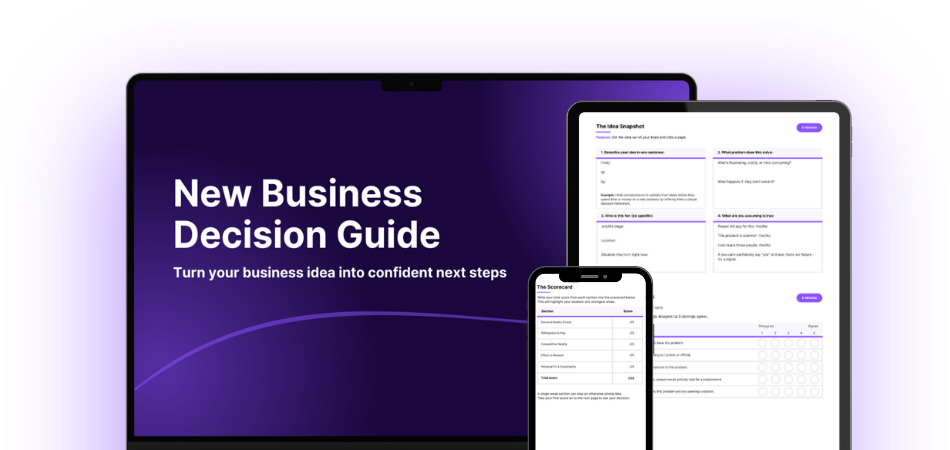
The New Business Decision Guide is for exactly this moment.
It’s a free, scored framework that walks you through the 25 questions that actually determine whether a business idea is worth pursuing – before you spend time, money, or energy building something the market doesn’t want.
No fluff. No generic advice. Just clarity on where your idea is strong, where it needs work, and what to focus on next.
Download the New Business Decision Guide – it’s free →
If you’re serious about starting something, start here.