

You have an idea. Maybe you’ve had it for a while. And every time you think about actually doing something with it, you open a new tab, read three conflicting articles, and close your laptop feeling more confused than when you started.
That’s not a lack of commitment, and it certainly doesn’t mean you don’t have what it takes – it’s a lack of a clear starting point.
This guide gives you just that. No business degree required, no marketing experience needed. Just the first steps to take when you have an idea and want to figure out if it’s worth backing.
Why starting feels so overwhelming
Most people don’t struggle to start because they’re not motivated. They struggle because there’s too much information and none of it is in the right order.
You search “how to start a business” and you get advice about LLC structures, pitch decks, and venture capital. None of which matters yet. None of which is where you begin.
The truth is, the first steps to starting a business are simpler than the internet makes them look. The hard part isn’t knowing what to do – it’s knowing what to do first.
What do you actually need to do first to start a business?
Before you build a website, register a company name, or post on Instagram, there is one thing that matters more than anything else.
Find out if people want what you’re selling.
That’s it. Everything else comes after that. A business that solves a real problem for real people can survive a lot. A business built on an untested idea, no matter how beautifully branded, usually can’t.
So your first job is validation – checking whether your idea has legs before you invest serious time or money into it.
How to validate your business idea (before you commit to anything)
Validation doesn’t have to be complicated. It comes down to five things:
1. Is there demand for what you’re offering? Are people already searching for this, paying for something similar, or telling you they need it? Demand that already exists is much easier to tap into than demand you have to create.
2. Will people actually pay for it? An idea people like is not the same as an idea people will pay for. Talk to potential customers. Ask what they currently spend to solve this problem. Free tools have a very different market to paid ones.
3. How competitive is the space? Competition isn’t automatically bad – it usually means there’s a real market. But you need to understand who else is out there and what you’d do differently.
4. Is the effort worth the reward? Starting a business takes time, energy, and usually money. Be honest about what you’re signing up for and whether the potential return justifies it for your life right now.
5. Does this fit you? Skills, lifestyle, interests. A business you’re miserable running is not a good business, no matter how profitable it looks on paper.
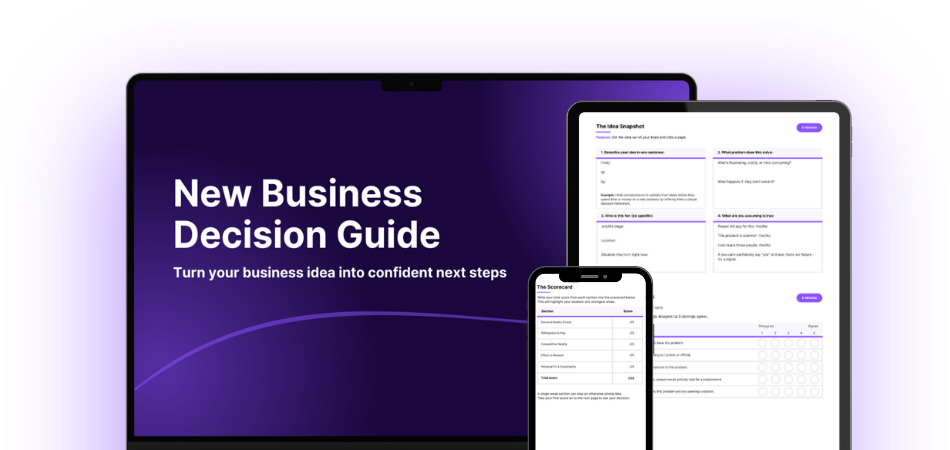
If you want a simple way to score your idea across all five of these areas, the New Business Decision Guide walks you through exactly this – free, no fluff. Download it here.
Where do I start when starting a business? A simple order of operations
Once you’ve validated your idea, here’s the order that actually makes sense:
- Talk to potential customers before you build anything
- Define the one problem you solve and who you solve it for
- Work out how you’ll make money and what you’ll charge
- Test a simple version of your offer before investing in branding or tech
- Build your presence once you have proof people want what you’re selling
Most people do this backwards. They spend months on a logo and a website before they’ve spoken to a single potential customer. Starting in the right order saves you months of wasted effort.
Your next step
You don’t need to have everything figured out. You just need to know what to figure out next.
Start with your idea. Put it through the five questions above. If you want a structured framework to do that properly, download the New Business Decision Guide – it’s free, it takes about 30 minutes, and it will clearly tell you whether your idea is ready rather than endlessly confusing conversations with AI.
Download the New Business Decision Guide — it’s free →
FAQ
Where do I start when I want to start a business? Start with validation – finding out whether people want and will pay for your idea before you invest time or money building it. Talk to potential customers, research whether demand exists, and check what competition looks like. Everything else comes after you have that answer.
How do I start a business with no experience? No prior business experience is needed to start. What matters most is understanding the problem you’re solving and who you’re solving it for. Start simple, test your idea before committing fully, and build your knowledge as you go. Most successful business owners learned by doing.
What is the first step to starting a business? The first step is validating your idea. Before you register a business name, build a website, or create a logo, find out whether real people have the problem you’re solving and whether they’d pay to have it fixed.
How do I know if my business idea is ready? Look at five things: demand, willingness to pay, competition, effort versus reward, and personal fit. If your idea holds up across all five, it’s worth pursuing. If it doesn’t, that’s not failure – that’s months of time and money saved.